Strategy
The "TACO" Rebound: How to Position When Policy Drives the Market

Christopher Gerace
6 Minutes

After another "TACO" moment steadied markets, here's how we're thinking about positioning - quality equities, gold, private credit and real assets in a policy-driven, volatile market.
After wiping roughly US$2 trillion from the S&P 500 last week with threats of 100% tariffs on Chinese imports, President Trump reversed tone mid-flight to the Middle East, assuring followers that “it will all be fine” and that the U.S. “wants to help China, not hurt it.”
Equity futures rebounded modestly in Asia and the ASX 200 closed only 0.84% lower, while gold eased slightly after a sharp rally. However, the Hang Seng Index fell 1.5% and its Tech Index fell 1.82%, underscoring how fragile sentiment remains across China and broader emerging markets. While the immediate panic has subsided, the underlying risks remain unchanged, stretched valuations and deteriorating confidence among US consumers.
Market Overview
Trade and tariffs remain a structural headwind. Even without new measures, existing tariffs have yet to be fully passed through to US consumers, meaning the inflationary drag is still ahead.
Valuations are stretched. AI-driven enthusiasm has lifted equity multiples to levels unsupported by underlying earnings growth.
Volatility is reawakening. The days of smooth rallies are fading as policy unpredictability and global fragmentation persists.
Strategic Positioning
Equities - Prioritise quality and earnings resilience
Being mindful of exposure to cyclical and China-dependent sectors (luxury, semiconductors, export-heavy industrials).
Companies with robust free-cash flow, pricing power, low leverage, and limited refinancing needs.
Back AI adopters (firms deploying AI to improve margins) rather than over-valued “AI narrative” names.
Favour domestic or regional leaders with predictable earnings while trade uncertainty persists.
Gold & Precious Metals - Maintain a strategic diversifier
Structure:
Core: Physical or unhedged bullion for protection.
Satellite: Diversified gold or silver miners for upside, scaled for volatility.
Credit - Disciplined manager selection is critical
First-mortgage private credit remains attractive for stable income and has a low correlation to equities and the structural seniority provides resilience amid volatility.
Complement with investment-grade fixed income (short- to medium-duration) to capture high real yields.
Avoid funds with aggressive LVRs, limited disclosure or exposure to stretched borrowers.
Private Equity - Uncorrelated growth, but selectivity matters
Private equity and venture capital allocations offer access to long duration growth uncorrelated with short-term market moves.
Manager selection drives outcomes:
Avoid first time funds with untested strategies.
Continue to work with tier-one family offices and institutional co-investment partners where we have visibility across pipeline assets.
Bonds - Use Duration Strategically
Barbell approach:
Short-term maturities (0-2 years) for liquidity and reinvestment flexibility.
Select 7-10 year sovereigns as portfolio insurance against further growth stocks.
Duration is used as a hedge, not a yield play.
Liquidity & Portfolio Flexibility
Maintain cash to act as a liquidity provider during market downturns.
Portfolio adjustments to manage tax and slippage.
Real Assets and Commodities
Exposure to income generating assets with inflation linkage (e.g., infrastructure, logistics and essential services).
Keep a measured allocation to transition metals (e.g., copper and nickel), through diversified producers; sized carefully due to volatility.
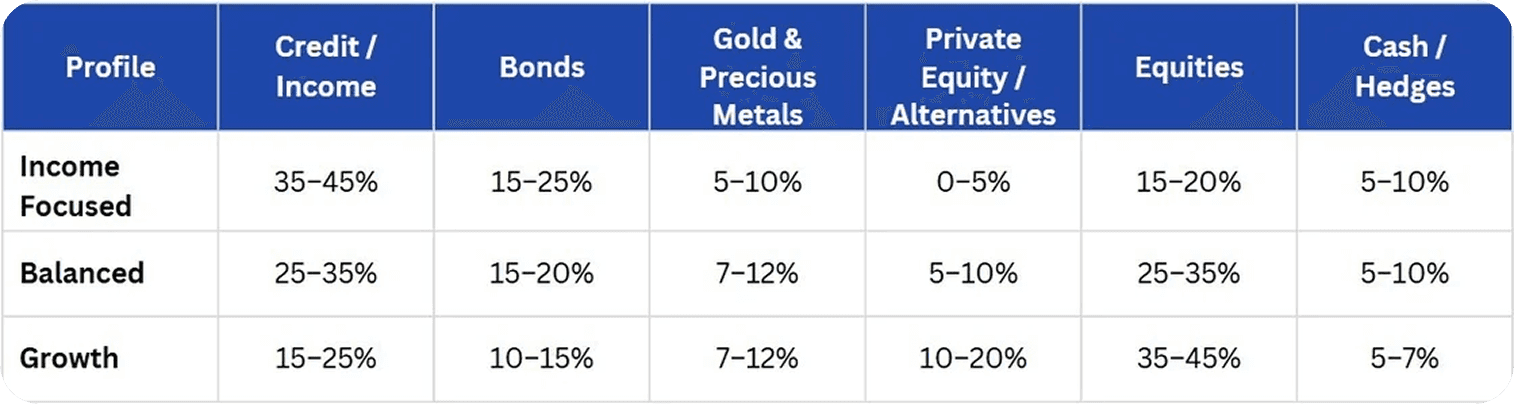
Illustrative Portfolio Framework
Key Takeaways
Expect continued volatility as geopolitical and fiscal pressures intersect.
Focus on quality, liquidity and genuine diversification, including unlisted and real assets not tied to daily market sentiment.
Use market weakness to rebalance, not retreat; opportunities emerge when capital is patient.
Gold remains a strategic diversifier and store of value in an environment of currency and fiscal uncertainty.


